
DIY Bookkeeping vs Hiring a Bookkeeper: Which Is Better for Your Business?
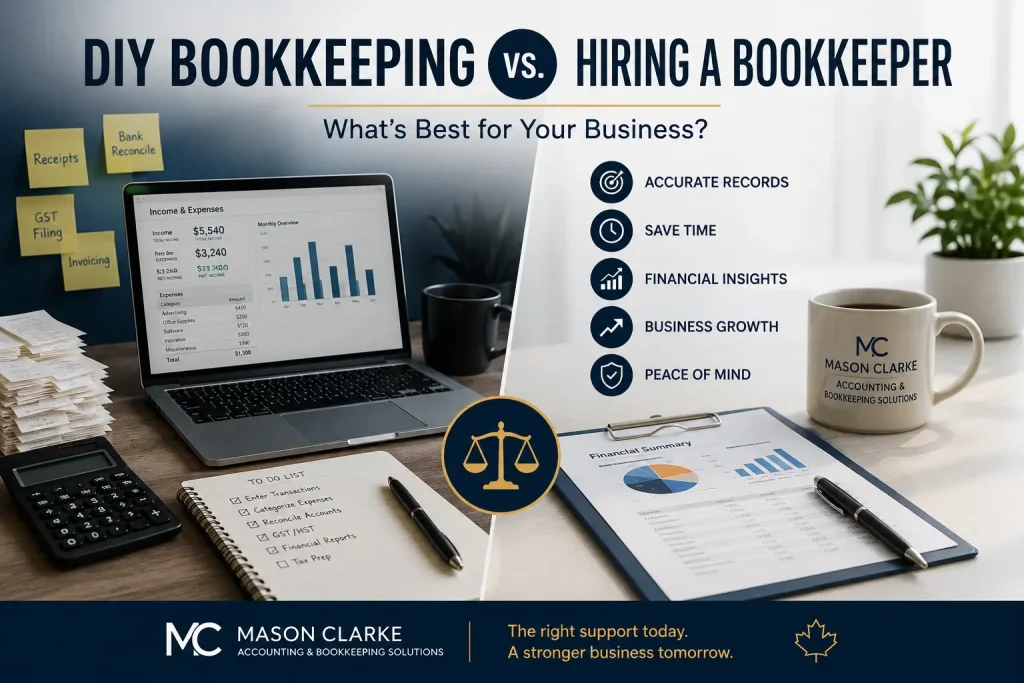
When you’re running a small business, every expense matters. That can make DIY bookkeeping seem like an easy decision. If accounting software can automatically import transactions, categorize expenses, create invoices, and generate financial reports, why pay someone else to do it? For some businesses, doing your own bookkeeping can absolutely make sense. But bookkeeping is more than entering income and expenses into software. Your records need to be accurate, organized, reconciled, and detailed enough to support your tax and financial obligations. In Canada, the CRA requires businesses to maintain books, records, and supporting documents that contain enough information to determine their tax obligations and entitlements. Records generally need to be kept for six years. So the real question isn’t: “Can I do my own bookkeeping?” You probably can. The better question is: “Is doing my own bookkeeping the best use of my time, and can I maintain accurate records as my business grows?” DIY Bookkeeping vs Hiring a Bookkeeper Here’s a quick comparison: DIY Bookkeeping Hiring a Bookkeeper Monthly cost Lower Higher Time required from owner Higher Lower Control over records High Shared Professional oversight Limited Yes Best for Simple businesses Growing or complex businesses Scalability Can become difficult Easier to scale Financial review Owner-managed Professional review Cleanup assistance Limited Available Ongoing support Limited Available Neither option is automatically better. The right choice depends on your business size, transaction volume, financial complexity, bookkeeping knowledge, and how much time you have available. What Is DIY Bookkeeping? DIY bookkeeping means the business owner handles their own day-to-day financial records rather than outsourcing the work to a bookkeeper. This usually involves using accounting software such as QuickBooks Online to: Modern accounting software can make many of these tasks considerably easier. QuickBooks, for example, can connect bank accounts, import transactions, track expenses, capture receipts, create invoices, and produce financial reports. But software doesn’t eliminate the need for someone to make appropriate accounting decisions. A transaction still needs to be categorized correctly. Accounts still need to be reconciled. Errors still need to be identified. And someone needs to understand whether the financial reports actually make sense. When DIY Bookkeeping Makes Sense DIY bookkeeping can be a reasonable option if your business is relatively simple. You may be able to manage your own books if you: For example, imagine a freelance graphic designer who has 30–50 transactions each month, one business bank account, no employees, and relatively straightforward expenses. That business may not need a bookkeeper every week. With the right accounting software and a consistent process, the owner may be able to keep the books updated themselves and have an accountant review the records when necessary. The Biggest Advantage of DIY Bookkeeping: Cost The obvious benefit is money. If you do the work yourself, you don’t have to pay someone else for the bookkeeping hours. You may still have expenses for accounting software, receipt management, payroll software, or other tools, but those costs can be considerably lower than outsourcing the entire bookkeeping function. For a new business with limited revenue, keeping expenses low can be important. However, there’s one cost that is easy to overlook: Your time. If bookkeeping takes you five hours every month, those aren’t necessarily five free hours. What could you have done with those five hours? Could you have: The financial cost of DIY bookkeeping isn’t just the software subscription. It’s also the opportunity cost of the owner’s time. What Does a Bookkeeper Actually Do? A professional bookkeeper does more than simply enter transactions. Depending on the arrangement, bookkeeping services can include: A bookkeeper can also provide another layer of review. That’s particularly valuable when a business owner is busy running the company and doesn’t have the time or expertise to investigate why the numbers don’t look right. When Should You Hire a Bookkeeper? There isn’t a specific revenue number at which every business should hire a bookkeeper. A business making $100,000 a year might have very simple bookkeeping. Another business making $100,000 might have hundreds of transactions, employees, inventory, multiple accounts, and complicated sales tax requirements. Complexity matters more than revenue alone. Here are some signs that it may be time to consider professional bookkeeping. 1. Your Books Are Falling Behind If you keep telling yourself: “I’ll update the books this weekend.” And then three months pass, that’s a warning sign. Bookkeeping becomes much harder when months of transactions accumulate. Regular bookkeeping keeps financial information current and makes it easier to identify problems while they are still manageable. 2. You Don’t Know Your Numbers If someone asks: “How much did your business actually make last month?” and you don’t know, your bookkeeping isn’t giving you much value. Current financial records can help you understand revenue, expenses, profitability, cash flow, and outstanding receivables. 3. Your Business Has Become More Complicated As a business grows, bookkeeping often becomes more complicated. You might add: At that point, the bookkeeping process that worked when you were a one-person business may no longer be sufficient. 4. GST/HST Is Becoming Difficult to Manage GST/HST introduces additional recordkeeping requirements. The CRA states that businesses must keep sales and purchase invoices and other records related to their GST/HST activities to support their returns and input tax credit claims. If you’re unsure whether transactions are being recorded correctly or whether your records support your GST/HST reporting, professional bookkeeping can provide additional oversight. 5. You’re Spending Too Much Time on Bookkeeping This is one of the simplest tests. Ask yourself: How many hours am I spending on bookkeeping every month? Then ask: Could those hours be spent generating revenue or running the business? If bookkeeping regularly takes you away from higher-value work, outsourcing may make financial sense even if you technically have the ability to do it yourself. DIY Bookkeeping vs Hiring a Bookkeeper: The Real Cost Suppose a business owner spends six hours every month doing bookkeeping. That’s 72 hours per year. If that owner could use those hours to generate additional business, the value of DIY bookkeeping
How Much Does a Bookkeeper Cost in Canada?

If you run a small business in Canada, one of the first questions you may ask before hiring a bookkeeper is: How much does a bookkeeper cost? There isn’t one standard bookkeeping rate across Canada. A freelance bookkeeper may charge an hourly rate, while a professional bookkeeping firm will often offer a fixed monthly package. Your actual cost depends on factors such as the number of transactions your business has, how many accounts need to be reconciled, whether you need payroll or GST/HST support, and how much cleanup your books require. For many Canadian small businesses, outsourced bookkeeping falls somewhere between $300 and $2,000+ per month, while more complex businesses can pay considerably more. Current Canadian pricing guides commonly place typical small-business bookkeeping in the several-hundred-dollar-per-month range, with costs increasing as transaction volume and accounting requirements grow. The important question, therefore, isn’t simply “What does a bookkeeper charge?” It’s “What should I expect to pay for the level of bookkeeping my business actually needs?” Average Bookkeeping Cost in Canada Here is a general guide to what Canadian businesses may encounter when looking for bookkeeping services: Type of bookkeeping Typical cost in Canada Basic freelance bookkeeping $30–$60+ per hour Experienced/specialized bookkeeper $60–$100+ per hour Basic monthly bookkeeping $300–$600+ per month Typical small-business bookkeeping $500–$1,200+ per month More complex bookkeeping $1,200–$2,000+ per month Complex accounting/back-office support $2,000+ per month These figures are general market ranges rather than fixed Canadian rates. Pricing varies substantially between providers and businesses. Recent Canadian pricing sources report freelance rates around $30–$90 per hour and outsourced monthly services ranging from approximately $300 to $2,000 or more. A very small business with a limited number of monthly transactions may need only a few hours of bookkeeping each month. A company with multiple bank accounts, payroll, inventory, sales tax obligations, and hundreds of transactions can require significantly more work. How Do Bookkeepers Charge in Canada? Canadian bookkeepers generally use one of three pricing structures. 1. Hourly Bookkeeping Rates With hourly bookkeeping, you pay for the time your bookkeeper spends working on your accounts. For example, if a bookkeeper charges $50 per hour and spends six hours maintaining your books, your bookkeeping cost would be $300 for that period. Hourly pricing can make sense when: The downside is that your monthly bill can fluctuate. If your books require more work than expected, the final invoice can be higher. 2. Fixed Monthly Bookkeeping Fees Many professional bookkeeping firms use a fixed monthly fee instead. Rather than paying for every hour separately, you agree on a recurring price based on the services and workload involved. For a small business, a monthly package might include: Fixed pricing can make budgeting easier because you know what your regular bookkeeping expense will be. 3. Customized Bookkeeping Packages Some businesses need more than basic monthly bookkeeping. For example, a growing corporation may require bookkeeping alongside financial reporting, payroll coordination, accounts receivable, accounts payable, or management reporting. In that situation, a bookkeeping firm may create a customized package rather than placing the business into a standard tier. This approach is particularly useful because the cheapest bookkeeping package isn’t necessarily the most appropriate one. Paying for services you don’t need wastes money, while choosing a package that is too limited can leave important financial work unfinished. What Determines the Cost of a Bookkeeper? Two businesses with the same annual revenue can have completely different bookkeeping costs. Here are some of the biggest factors. Transaction Volume Transaction volume is one of the most important factors. A business making 30 transactions a month is generally much simpler to maintain than one processing 500 or 1,000 transactions. More transactions mean more entries to categorize, reconcile, review, and potentially correct. Number of Bank and Credit Card Accounts A business with one bank account and one credit card is relatively straightforward. If you have several operating accounts, credit cards, loans, merchant accounts, or other financial accounts, the bookkeeping workload increases. Each account needs to be properly reconciled and reviewed. Payroll Payroll can add another layer of bookkeeping complexity. If you have employees, your bookkeeping requirements may include recording payroll transactions, tracking payroll liabilities, reconciling payroll accounts, and ensuring the books accurately reflect payroll-related activity. Payroll services may be priced separately depending on the provider. GST/HST Businesses registered for GST/HST may require additional bookkeeping work to ensure sales and expenses are recorded correctly and the information needed for tax filings is available. The more complicated your sales tax situation becomes, the more important accurate bookkeeping becomes. Accounts Payable and Accounts Receivable Some businesses only need their transactions recorded. Others want their bookkeeper to actively manage receivables and payables. That can include maintaining customer invoices, tracking amounts owed, recording supplier bills, and keeping outstanding balances organized. The additional responsibilities can increase the monthly bookkeeping fee. Industry Your industry can also affect bookkeeping costs. A simple professional-services business may have relatively straightforward books. A construction company, restaurant, real estate business, nonprofit, or company holding inventory may have more complicated transactions and reporting requirements. Condition of Your Existing Books This is an often-overlooked cost. There is a major difference between maintaining clean books and fixing months or years of disorganized bookkeeping. If accounts have not been reconciled, transactions are miscategorized, receipts are missing, or previous bookkeeping contains errors, a bookkeeper may need to perform cleanup work before regular monthly bookkeeping can begin. Year-end cleanup can range from hundreds to several thousand dollars depending on how far behind the business is and how complicated the records are. How Much Does a Part-Time or Freelance Bookkeeper Cost? Hiring a freelance bookkeeper can be an economical option for a small business that doesn’t need full-time financial support. Canadian freelance bookkeeping rates commonly fall in the $30–$90+ per hour range, depending on experience, specialization, location, and the type of work involved. For example, a business requiring five hours of bookkeeping per month might spend approximately $150–$450 at those rates. However, comparing bookkeepers purely by hourly rate can be misleading. A bookkeeper